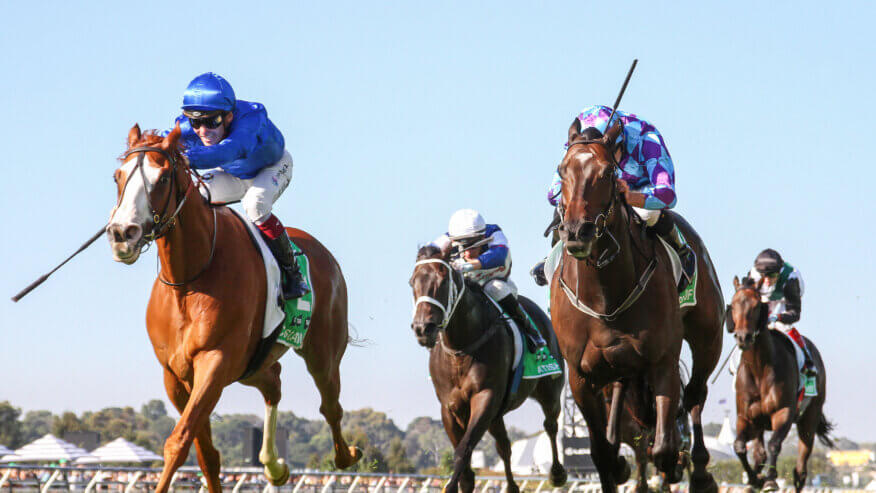
The 2026 Australian Cup ran on Saturday March 28 at Flemington, Melbourne, Australia and was won in a thrilling photo-finish by the defending champion Light Infantry Man ($21) for trainer Ciaron Maher!
Australian Cup 2026 Results
| 2. Light Infantry Man (9) J: Harry Coffey 59kg 52x14 T: Ciaron Maher | ||
| 8. Pride Of Jenni (10) J: Declan Bates 57kg 718x3 T: Ciaron Maher | ||
| 3. Apulia (2) J: William Pike 59kg 01152 T: Ben, Will & Jd Hayes | ||
| 6. Sabaj (6) J: Beau Mertens 59kg 10x24 T: Mick Price & Michael Kent Jnr | ||
| 5. Birdman (5) J: Ben Melham 59kg 8x411 T: Chris Waller | ||
| 10. Leica Lucy (3) J: Damian Lane 57kg 32x56 T: Chris Waller | ||
| 1. Tom Kitten (12) J: Craig Williams 59kg 53x11 T: Anthony & Sam Freedman | ||
| 11. Basilinna (8) J: Jye Mcneil 57kg 1x7x7 T: Emma-Lee & David Browne | ||
| 12. Philia (7) J: Daniel Stackhouse 57kg 8x644 T: David Vandyke | ||
| 9. Damask Rose (1) J: Jamie Melham 57kg x2327 T: Mark Walker | ||
| 7. Mark Twain (4) J: Lachlan Neindorf 59kg 009x3 T: Phillip Stokes | ||
| 4. Just Fine (11) J: Jordan Childs 59kg 29x93 T: Gai Waterhouse & Adrian Bott |
Australian Cup Info
- 2026 Australian Cup Date: Saturday the 28th of March 2026
- Track Location: Flemington Racecourse, Melbourne, Victoria, Australia
- Distance: 2,000m
- Conditions: Weight-For-Age; 3YOs & Upwards
- Status: Group 1
- Prize Money (AUD): $2,000,000
- First Run: 1863
- Reigning Australian Cup Winner: Light Infantry Man (2025 & 2026)
Looking for the latest Australian Cup betting odds, insider racing tips and form for the Flemington Group 1 weight-for-age race this March? The TAB NZ have all the best betting guides and statistics to make informed bets on the Australian Cup race this autumn!
The Group 1 Australian Cup is prestigious weight-for-age test for Australia’s top staying racehorses. It is one of the most popular Group 1 races held each Melbourne Autumn Racing Carnival and traditionally takes place at Melbourne’s iconic Flemington Racecourse on a Saturday in late March as part of the coveted Australian Cup Day race card conducted by the Victoria Racing Club (VRC).
It is considered one of Australia’s premier WFA races and attracts some of the best longer-distance horses in the country with AU$2 million in prize money on offer.
To improve your chances of predicting the next Australian Cup winner, access the latest Australian Cup odds and tips online at the TAB NZ.
TAB NZ provides in-depth analysis, form guides, and betting insights to help you navigate the competitive field of autumn contenders.
Whether you’re a seasoned punter or new to betting on the horse races in Australia and New Zealand, our comprehensive Australian Cup coverage has everything you need.
Get in on the winning action at Headquarters – place your bet on the Australian Cup via TAB NZ now!
Australian Cup Fast Facts
- Last mare to win the Australian Cup: Duais (2022)
- Last three-year-old to win the Australian Cup: Super Cool (2013)
- Last filly to win the Australian Cup: None since the race became a 2000m event in 1973
- Last dual Australian Cup winner: Light Infantry Man (2025 & 2026)
- Last favourite to win the Australian Cup: Cascadian ($4 in 2023)
- Notable Fact: The 1988 Australian Cup winner Dandy Andy beat home the favourite Vo Rogue at $126!

Bet on the next Australian Cup race now!
Australian Cup Betting Info
Australian Cup betting is open months ahead of the Group 1 Flemington, autumn race at the TAB NZ.
We offer pre-nomination Australian Cup betting odds throughout the year that are known as futures Australian Cup odds online.
All-In Australian Cup betting markets are then available following the official Australian Cup nominations taken the on the Monday of race week.
Betting on the Australian Cup field is available following final acceptances on the Wednesday of race week.
Betting on the Australian Cup favours the locally trained champions from the best Australian horse racing stables in Melbourne and Sydney.
Australian Cup race betting traditionally focuses on any past Group 1 winning gallopers who have an outstanding record in the event and the older horses aged six and above who have dominated recent results over their younger counterparts.
Australian Cup race tips centre on the standout weight-for-age champion thoroughbreds in Australia and New Zealand that have good lead-up form in similar grade autumn events, horses with previous experience at the Flemington track and the runners from the key stables including the Lindsay Park team who have dominated recent Australian Cup race results.
The Australian Cup is a weight-for-age event open to horses aged three-years-old and above.
Expert Tips On The 2026 Australian Cup
Stay tuned for our expert tips and Australian Cup betting predictions ahead of this year’s Group 1 feature at Flemington.
| 5. Birdman (5) J: Ben Melham 59kg 8×411 T: Chris Waller |
| 1. Tom Kitten (12) J: Craig Williams 59kg 53×11 T: Anthony & Sam Freedman |
| 2. Light Infantry Man (9) J: Harry Coffey 59kg 52×14 T: Ciaron Maher |
Australian Cup Tips
Australian Cup tips on which horse will win the next edition of Victoria’s 2000m feature flood in as the countdown to the important Flemington race heats up.
Australian Cup race tips on what horse will win the event this year are highly sought after by smart punters and racing fans every season.
When looking at Australian Cup race tips it is important to consider factors including:
- What horses in the Australian Cup field are proven over the 2,000m distance?
- Who the key Australian Cup trainers and jockeys are and what horses they have in the Australian Cup field this year?
- Australian Cup barrier statistics and where your Australian Cup betting selections are drawn.
- Australian Cup horses that have a good past record at the track.
How long does it take to know if you placed a winning Australian Cup race tip? The event itself takes around two minutes for the competing horses to run the 2,000m trip depending on track conditions.
The official Australian Cup winner and winning Australian Cup trifecta are known shortly after unless there is a protest or a photo-finish Australian Cup result.
Who holds the Australian Cup race record? Makybe Diva holds the current 2000m Australian Cup race record winning in 2005 in a time of 1 minute 58:73 seconds.
What are the best Australian Cup lead-up races to look at when placing an Australian Cup bet?
There are a number of earlier autumn races Australian Cup bound horses may contest in the lead-up including the Group 2 Peter Young Stakes (1800m) at Caulfield in late February, the Group 2 Blamey Stakes (1600m) at Flemington in early March, and the Group 1 All-Star Mile (1600m) now held at Flemington around two weeks before.
Light Infantry Man (3rd in 2025) was the last All-Star Mile graduate to continue on and win the Australian Cup.
Light Infantry Man (4th in 2026) was the last Peter Young Stakes graduate to win the Australian Cup.
Internationally Bred Horses in the Australian Cup
Betting on the internationally bred horses in the field is popular with punters with the race results showing a dominance of Australian Cup winners bred outside of Australia in recent history.
In the years from 2014 to 2026, just one of the 13 Australian Cup winners was bred in Australia with Duais (2022). In that time, two New Zealand bred horses won with Preferment (2016) and Humidor (2017).
Australian Cup Tips for a Trifecta
Australian Cup tips for a trifecta cover the first three horses to officially go past the finishing post in the Australian Cup results.
The horse to finish on top of the Australian Cup trifecta is your Australian Cup winner, the runner who outlasted all their rivals and finished in the fastest time.
Placing an Australian Cup trifecta exotic bet on the race is a great way to add to the thrill and potentially be rewarded with a generous pay-out.
An Australian Cup trifecta is only successful if the three horses in your bet finish in the exact order you predict. Punters may choose instead to box their trifecta bets on the Australian Cup to cover more finishing options and increase the chances of winning.
Laying the favourite in your Australian Cup bets is a top tip as the favourites have a poor recent strike-rate in the event.
Key Australian Cup Statistics and Insights
Place an informed bet on this year’s Australian Cup by considering the following key statistics and insights:
- Win Rates: Horses with high win rates in similar races are strong contenders for the Australian Cup. Our Australian Cup betting tips available at the TAB NZ Punters Lounge provide detailed win rate statistics.
- Place Percentages: Evaluate horses with consistent place percentages, indicating reliability and competitiveness. Australian Cup race tips offer comprehensive data on place percentages.
- Barrier Success Rates: Horses starting from barriers 8 – 12 historically shown a higher success rate in the Australian Cup.
2026 Australian Cup Field
Nominations close: Monday March 23, 2026, at 12:00PM AEDT
Weights declared by: Monday March 23, 2026, at 4:00PM AEDT
Acceptances must be declared before: Wednesday March 25, 2026, at 9:30AM AEDT
Riders must be declared before: Wednesday March 25, 2026, at 1:00PM AEDT

Australian Cup betting takes place on the prestigious race which is held at Melbourne’s Flemington Racecourse on a Saturday in late March annually.
It was previously held earlier in the month alongside the Group 1 Newmarket Handicap (1200m) on ‘Super Saturday’ before moving to its own feature race day a fortnight later in 2023.
Australian Cup odds are offered on the esteemed Group 1 weight-for-age event, and the field attracts a host of quality thoroughbreds many of which are eyeing other Group 1 targets.
It has been both a handicap (1863-1978; 1983-1986) and WFA (1979-1982; 1987 onwards) race throughout the years.
The Group 1 Australian Cup is one of Australia’s most famous autumn horse races and has been run and won since 1863 when Barwon became the inaugural champion of the event.
The 2007 Australian Cup was conducted at Caulfield Racecourse with Flemington undergoing construction with Pompeii Ruler winning that year.
It has been a key event on Australia’s racing calendar for over 160 years and continues to attract the best horses, jockeys and trainers from across the country and New Zealand.
A host of reining or subsequent Melbourne Cup winners have also added their names to the Australian Cup winners list including Let’s Elope, history’s only three-time Melbourne Cup champion Makybe Diva, Shocking and Fiorente.
There have been many other standout horses to win the Australian Cup throughout history. From the raw power of Vo Rogue, who captured back-to-back titles in 1989 and 1990, to the regal dominance of Saintly in 1996, the race has consistently attracted and showcased Australia’s finest middle-distance gallopers.
Makybe Diva’s record-breaking 2005 victory stands as a testament to the race’s capacity to produce moments of sheer racing excellence. More recently, horses like Lonhro, Northerly and the dual champ Cascadian have added their names to the honored role of Australian Cup winners.
Winning the Australian Cup is a significant achievement in the racing community, and the event attracts lots of attention from punters both locally and internationally in New Zealand.
Taking place at Flemington Racecourse in Victoria on the east coast of Australia, the Australian Cup is a 2000m event and only the top racehorses prevail.
Once Australia’s premier staying event, the Australian Cup distance initially stretched over 18 furlongs (3621m), surpassing the two-mile distance of the world-famous Melbourne Cup race, before being shortened to 17 furlongs 110 yards in 1943 to accommodate larger fields and a start from Flemington’s Straight Six.
Subsequently, in the early 1960s, the Victoria Racing Club further reduced the distance to 1+1⁄4 miles to attract higher-caliber middle-distance horses. It has been run and won over 2000m since 1973 the year Gladman won.
The Australian Cup was elevated to Group 1 status in 1979 with Dulcify winning the first official running as an elite level event.
Australian Cup Day
The 2026 Australian Cup Day meeting is set to take place on Saturday, March 28th at Flemington Racecourse.
This marquee event features the prestigious $2 million Group 1 Australian Cup over 2000m, attracting top horses, jockeys, and trainers.
The day also includes Group 3 Thoroughbred Breeders Stakes (1200m) for two-year-old fillies along with a number of Listed races led by the $300,000 Listed Lexus Roy Higgins race, offering the first golden ticket for the 2026 Lexus Melbourne Cup on the first Tuesday of November back at Flemington during the spring.
In addition to the thrilling races, the event features the Fashions on the Field competition, live entertainment, and a variety of food and beverage options as part of the Melbourne Food and Wine Festival.
The Australian Cup runs in Melbourne on the same day Sydney hosts the Group 1 Tancred Stakes (2400m) and Group 1 Vinery Stud Stakes (2000m) at Rosehill.
Get the best Australian Cup Day racing odds for Flemington, racing stats, previews, form and insider tips on races like the meeting’s feature Group 1 event now at the TAB NZ!
Where can you bet on the Australian Cup?
The best place to bet on this year’s Australian Cup race is through the TAB NZ online.
Australian Cup Odds
Australian Cup odds and online betting tips on the Australian Cup horse race in Australia are dominated by proven Group 1 horses, the locally trained gallopers in the race and backing the male horses in the mix who have a strong recent record over their female counterparts in the event.
Where can I find the latest Australian Cup odds?
For the latest odds and updates on the Australian Cup, TAB NZ is your go-to source. They provide real-time odds fluctuations, ensuring you have the most current information to make informed betting decisions. It’s crucial to monitor these odds closely, as they reflect the market’s perception of each horse’s chances, influenced by factors like form, barrier draw, and track conditions.
How to Place a Bet on the Australian Cup
Want to know how to make a bet on the Australian Cup? Visit the TAB NZ racing page to access the latest Australian Cup betting odds and options.
It is simple to learn how to place a bet on the Australian Cup online.
You can place an Australian Cup bet online anytime markets are live.
There are more ways than ever to get involved in betting on the Australian Cup.
From seasoned punters analysing form guides to casual racing fans drawn to the excitement, the Australian Cup is a race for everyone.
Whether you’re diving deep into the latest Australian Cup race field, joining a sweepstake with friends, or simply enjoying the atmosphere of the autumn Flemington racing, the Australian Cup has it all!
This important autumn race showcases Australia’s finest thoroughbreds and attracts attention from all over the country and here in New Zealand as one of the best events in the autumn!
How to Bet on the Australian Cup this year?
1. Log in or sign-up with TAB NZ.
2. Make a secure online deposit using one of the TAB NZ safe deposit methods.
3. Check out the Australian Cup betting guide, Australian Cup form guide and our expert Australian Cup tips.
4. Choose an Australian Cup bet to place such as Win, Place, Each-Way or the Australian Cup Trifecta. There are many more Australian Cup betting options available so make sure to check out our Australian Cup betting markets.
5. Select the Australian Cup horse you want to bet on from the early markets, Australian Cup nominations or Australian Cup field.
Australian Cup Prize Money
The Australian Cup prize money is set at A$2 million in total stakes allocated between first to eighth place.
How much does the Australian Cup winner get?
The winning Australian Cup horse receives a total of A$1.2 million in prize money.
See below for the official breakdown of Australian Cup prizes on offer from the Australian Cup winner to the eighth horse to cross the finish line in the official Australian Cup results.
First: A$1,200,000
Second: A$360,000
Third: A$180,000
Fourth: A$$90,000
Fifth: A$50,000
Sixth – Eighth: A$40,000
How many horses have won the Australian Cup twice?
Nine horses have won multiple editions of the Australian Cup, most recently Cascadian (2023-24) and Light Infantry Man (2025-26).
To date no horse has won the Australian Cup more than twice.
The only dual Australian Cup winner so far to do so on non-successive years was the mighty Northerly in 2001 & 2003.
Multiple Australian Cup winners: Woodman (1865-66), Welkin (1962-63), Craftsman (1965-66), Ming Dynasty (1978-80), Vo Rogue (1989-90), Northerly (2001 & 2003), Harlem (2018-19), Cascadian (2023-24) and Light Infantry Man (2025-26).
What makes betting on the Australian Cup so popular?
The fact that the Australian Cup is one of the key Group 1 weight-for-age races run during the Melbourne Autumn Racing Carnival and one of the key March horse races in Australasia make it a must watch and must bet on racing event.
The event has become a traditional event on the Australian racing calendar, and therefore many people have a tradition of betting on the Australian Cup.
The Australian Cup is a popular middle-distance staying race that has produced a host of subsequent Group 1 winning horses both locally and across the Tasman.
The race attracts horses with established form, providing punters with valuable data and analysis opportunities. This allows for more informed betting decisions.
The Australian Cup often serves as a key lead-up race to other major events like those held during The Championships at Randwick including the Group 1 Doncaster Mile (1600m) and Group 1 Queen Elizabeth Stakes (2000m).
For the best online betting on the Australian Cup, consider tipping a horse to win both the Australian Cup and another Group 1 race over the carnival in an autumn race double!
The race’s competitive nature and the presence of high-profile horses provide numerous betting opportunities, from win/place bets to exotic bets like trifectas and quinellas.
What makes the Australian Cup so special?
The Australian Cup is held at the iconic Flemington Racecourse, known for its world-class facilities and for being home to the Melbourne Cup race on the first Tuesday of November, making it a favourite destination for racegoers in Victoria.
A blend of top-level racing, the presence of champion horses, and the social atmosphere of a major race day makes the Australian Cup a popular betting event.
The Australian Cup serves as a great guide historically to other important Australian and New Zealand Group 1 races so using the Australian Cup winners’ list for upcoming Group events is popular with punters.
It is a highly competitive and prestigious race that grows in popularity each autumn.
Australian and international racing fans, including those in New Zealand, tune into the thrilling 2000m autumn event every season to see if their bets on the Australian Cup race won!
The significant prize money associated with the Australian Cup increases the stakes and excitement for both participants and punters.
The Australian Cup currently offers AU$2,000,000 in prize money plus bragging rights with jockeys, trainers and owners from across the country and further abroad keen to add their names to the list of Australian Cup champions.
What are the popular betting markets for the Australian Cup?
When it comes to betting on the Australian Cup, there are a number of more popular betting options with punters including:
Exotics: These include Quinella, Trifecta, and First Four, where you predict the specific order of finishers, offering potentially higher payouts but requiring more precise predictions.
Win & Place: Bet on a horse to win or finish in the top places. This is one of the most straightforward and popular betting options.
Each-Way: A combination of win and place bets, providing a safety net if your chosen horse doesn’t win but finishes in the top positions.
How many mares have won the Australian Cup in recent years?
There have only been five Australian Cup winning mares in the last 35 years, most recently Makybe Diva (2005) and Duais (2022).
What age group has the best Australian Cup record?
Four-year-olds and six-year-olds have dominated the Australian Cup results in recent years seven from each age group with saluting between 2000 and 2026, most recently Duais (4YO in 2022) and Light Infantry Man (6YO in 2025).
The youngest recent Australian Cup winner was Super Cool who saluted as a three-year-old in 2013.
The oldest recent Australian Cup winner was Cascadian who won the race for the second time in 2024 as a nine-year-old.
Between 2000 and 2026 the breakdown of Australian Cup winners by age is as follows:
3YOs – 1 (latest Super Cool in 2013)
4YOs – 7 (latest Duais in 2022)
5YOs – 4 (latest Fifty Stars in 2020)
6YOs – 7 (latest Light Infantry Man in 2025)
7YOs – 5 (latest Light Infantry Man in 2026)
8YOs – 2 (latest Cascadian in 2023)
9YOs – 1 (latest Cascadian in 2024)
What races will runners out of the Australian Cup target next?
Following a run in the Australian Cup many horses will target upcoming autumn Group 1 features including the Group 1 Doncaster Mile (1600m) held at Randwick in early April, the Group 1 Queen Elizabeth Stakes (2000m) run on Day 2 of The Championships, and the Group 1 All Aged Stakes (1400m) over less distance in late April.
Australian Cup Barriers
The Australian Cup barrier draw and allocated Australian Cup starting gates play a key role for many punters when deciding on what horses to bet on in the big race.
What is the most successful recent Australian Cup barrier draw?
Barrier 8 has produced five Australian Cup winners between 2000 and 2026, most recently Cascadian in 2024.
Barrier 14 is the widest gate to produce an Australian Cup winner between 2000 and 2026 with Homesman in 2021.
Barrier 4 was the last gate to produce back-to-back Australian Cup winners with Harlem (2018 & 2019).
Barrier 9 is the latest Australian Cup winning barrier with Light Infantry Man in 2026.
Breakdown of winning Australian Cup barriers between 2000-26:
Barrier 1 – 0
Barrier 2 – 2 (latest Super Cool in 2013)
Barrier 3 – 0
Barrier 4 – 4 (latest Light Infantry Man in 2025)
Barrier 5 – 3 (latest Manighar in 2012)
Barrier 6 – 0
Barrier 7 – 2 (latest Humidor in 2017)
Barrier 8 – 5 (latest Cascadian in 2024)
Barrier 9 – 3 (latest Light Infantry Man in 2026)
Barrier 10 – 3 (latest Cascadian in 2023)
Barrier 11 – 0
Barrier 12 – 2 (latest Shocking in 2011)
Barrier 13 – 2 (latest Fifty Stars in 2020)
Barrier 14 – 1 (latest Homesman in 2021)
Australian Cup Form
We offer a complete Australian Cup form guide and expert analysis on every horse in the Australian Cup field in addition to insider Australian Cup racing tips and betting odds.
Our Australian Cup form guides include:
- Australian Cup race preview and predictions
- Racing analysis on the event and runners
- Previous runs, barrier trials and lead-up statistics
- Key information on all horses in the race like trainer and jockey form
- Runner commentary
Whether you are just starting out tipping horses in the Australian Cup or you are an expert Australian Cup tipster, our form guide gives you all the statistics and information you need to make a smart bet on the Australian Cup.
How to Read the Australian Cup Guide
Here’s a step-by-step explanation of how to interpret a horse’s form and performance indicators when looking at this year’s Australian Cup form guide:
Barrier Position: Evaluate the horse’s barrier draw and its historical performance from similar starting positions.
Recent Performances: Review the horse’s last few races, focusing on finish positions and the quality of competition faced.
Track and Distance Records: Check the horse’s performance on similar track conditions and distances to gauge suitability.
Jockey and Trainer Stats: Consider the success rates of the jockey and trainer combination, particularly in the Australian Cup race.
Weight Carried: Analyse how the weight carried in previous races compares to the Australian Cup, as this can impact performance.
Australian Cup Results
The Australian Cup results are known when the event takes place in March annually.
You can bet on the Australian Cup race results weeks ahead of race day with our futures Australian Cup markets here at the TAB NZ.
Betting on the Australian Cup results entails picking the Australian Cup winning horse and we can help you place an informed bet on the Australian Cup field with our Australian Cup tips and form guide.
Other Australian Cup race results include the winning jockeys, trainers, successful barrier and finishing time.
The complete Australian Cup finishing order shows what position every horse in the field ran.
Some punters even like to place bets on what horse will finish last in the Australian Cup results!
Australian Cup exotic results show how all the exotic Australian Cup bet types resulted like the Australian Cup Quinella, Australian Cup Exacta, Australian Cup Trifecta, and Australian Cup First Four.
Australian Cup Jockeys
Securing a ride in the Australian Cup field is a highly sought-after achievement for jockeys around Australia and New Zealand. Winning this important autumn race is a nice campaign goal for many of Australasia’s top riders looking to secure a Group 1 trophy during the carnival.
What jockeys are riding in the Australian Cup field is determined by the owners and trainers of the horses, and official Australian Cup jockey announcements are made in the weeks and days leading up to the race.
Harry Coffey is the latest Australian Cup winning jockey having ridden Light Infantry Man to victory in 2026. The year before, Ethan Brown rode the same horse (Light Infantry Man) to victory in 2025.
Since 2005, no Australian Cup jockey has won the race more than twice.
Stay tuned to the TAB NZ racing blog to see what jockeys lock in a confirmed ride on one of the Australian Cup horses this summer.
Australian Cup Trainers
The most successful trainer in recent Australian Cup history is Bart Cummings with an incredible 13 winners starting with Arctic Coast (1968) and most recently with Sirmione (2008).
Ciaron Maher is the latest Australian Cup winning trainer having prepared Light Infantry Man for his back-to-back wins in 2025 and 2026.

Australian Cup Winners
Notable Australian Cup winners throughout history include:
Barwon (1863): Barwon was the inaugural winner of the Australian Cup in 1863. His victory marked the beginning of one of Australia’s most prestigious races. Barwon’s win set the stage for future champions to showcase their talent in this historic event.
Malua (1886): Malua is remembered as one of the most versatile racehorses in Australian history. He won the Australian Cup in 1886 and is also known for his victories in the Melbourne Cup, Newmarket Handicap, and Grand National Hurdle. Malua’s ability to excel over various distances and disciplines made him a standout performer.
Spearfelt (1927): Spearfelt won the Australian Cup in 1927, adding to his impressive record that included a victory in the Melbourne Cup in 1926. His success in both major races highlighted his stamina and racing prowess, making him a notable figure in Australian racing history.
Gay Icarus (1971): Gay Icarus was a champion racehorse who won the Australian Cup in 1971. His victory in this race was part of a stellar career that included wins in the Caulfield Cup and the Cox Plate. Gay Icarus’s versatility and consistency made him one of the top racehorses of his time.
Leilani (1975): Leilani was a dominant mare who won the Australian Cup in 1975. Trained by the legendary Bart Cummings, her victory in this race was part of a career that included multiple Group 1 wins, such as the Caulfield Cup and the Turnbull Stakes. Leilani’s success on the track made her a standout performer.
Dulcify (1979): Dulcify was a remarkable racehorse who won the Australian Cup in 1979. Known for his incredible turn of foot, Dulcify also won the Cox Plate and the Victoria Derby. His untimely death in the 1979 Melbourne Cup remains one of the most tragic moments in Australian racing history.
Hyperno (1981): Hyperno won the Australian Cup in 1981, adding to his Melbourne Cup victory in 1979. Known for his strong finishing bursts, Hyperno’s success in these major races highlighted his stamina and determination, making him a memorable figure in Australian racing.
Bonecrusher (1987): Bonecrusher, known as the “Big Red,” won the Australian Cup in 1987. His victory in this race was part of a career that included wins in the Cox Plate and the New Zealand Derby. Bonecrusher’s rivalry with Our Waverley Star in the 1986 Cox Plate is considered one of the greatest races in history.
Better Loosen Up (1991): Better Loosen Up won the Australian Cup in 1991, adding to his impressive record that included victories in the Cox Plate and the Japan Cup. His ability to compete and win at the highest level both domestically and internationally made him a standout performer.
Let’s Elope (1992): Let’s Elope was a champion mare who won the Australian Cup in 1992. Her victory in this race was part of a career that included wins in the Melbourne Cup and the Caulfield Cup. Let’s Elope’s dominance in major races made her one of the top racehorses of her era.
Saintly (1996): Saintly, known as “The Horse from Heaven,” won the Australian Cup in 1996. Trained by Bart Cummings, his victory in this race was part of a career that included wins in the Melbourne Cup and the Cox Plate. Saintly’s versatility and consistency made him a beloved figure in Australian racing.
Octagonal (1997): Octagonal, also known as “The Big O,” won the Australian Cup in 1997. His victory in this race was part of a career that included multiple Group 1 wins, such as the Cox Plate and the Australian Derby. Octagonal’s tenacity and fighting spirit endeared him to racing fans.
Lonhro (2004): Lonhro, often referred to as the “Black Flash,” won the Australian Cup in 2004. His victory in this race was part of a career that included 26 wins from 35 starts, with 11 Group 1 victories. Lonhro’s consistency, versatility, and striking appearance made him a fan favourite and a true champion.
Makybe Diva (2005): Makybe Diva, the only horse to win the Melbourne Cup three times, won the Australian Cup in 2005. Her victory in this race was part of a career that included numerous major wins, making her one of the most celebrated racehorses in Australian history.
Fiorente (2014): Fiorente won the Australian Cup in 2014, adding to his Melbourne Cup victory in 2013. Trained by Gai Waterhouse, his success in these major races highlighted his stamina and racing prowess, making him a notable figure in Australian racing.
Cascadian (2023, 2024): Cascadian won the Australian Cup in consecutive years, 2023 and 2024. His victories in this race were part of a career that included multiple Group 1 wins, showcasing his consistency and ability to perform at the highest level over several seasons.
Light Infantry Man (2025, 2026): Ciaron Maher’s consistent WFA galloper Light Infantry Man scored back-to-back upsets in the 2025 and 2026 Australian Cup taking advantage of the hot speed set by his stablemate Pride OF Jenni on both occasions. In 2025, Pride Of Jenni faded late to run near the tail end but in 2026 she turned it into a stable fight having lead all-the-way before Light Infantry Man got his nose down right on the line to salute for the second year running at 20/1!
Bet on the next Australian Cup winner with our comprehensive Australian Cup form guide and expert Australian Cup tips at the TAB NZ!
Past Australian Cup Results
Recent Australian Cup winners, jockeys, trainers, barriers, and weights carried to victory dating back to the year 2005 are detailed in the below table.
| Year | Winner – Age/Gender Breeding | Jockey | Weight (kgs) | Trainer/s | Barrier |
|---|---|---|---|---|---|
| 2026 | LIGHT INFANTRY MAN (FR) 7G FAST COMPANY (IRE) – LIGHTS ON ME (GB) KYLLACHY (GB) | HARRY COFFEY | 59.0 | CIARON MAHER | 9 |
| 2025 | LIGHT INFANTRY MAN (FR) 6G FAST COMPANY (IRE) – LIGHTS ON ME (GB) KYLLACHY (GB) | ETHAN BROWN | 59.0 | CIARON MAHER | 4 |
| 2024 | CASCADIAN (GB) 9G NEW APPROACH (IRE) – FALLS OF LORA (GB) STREET CRY (IRE) | B MELHAM | 59.0 | JAMES CUMMINGS | 8 |
| 2023 | CASCADIAN (GB) 8G NEW APPROACH (IRE) – FALLS OF LORA (GB) STREET CRY (IRE) | B MELHAM | 59.0 | JAMES CUMMINGS | 10 |
| 2022 | DUAIS (AUS) 4M SHAMUS AWARD (AUS) – MEERLUST (AUS) JOHANNESBURG (USA) | J PARR | 57.0 | EDWARD CUMMINGS | 8 |
| 2021 | HOMESMAN (USA) 7G WAR FRONT (USA) – MY ANNETTE (USA) RED RANSOM (USA) | JYE MCNEIL | 59.0 | A & S FREEDMAN | 14 |
| 2020 | FIFTY STARS (IRE) 5H SEA THE STARS (IRE) – SWIZZLE STICK (IRE) SADLER’S WELLS (USA) | J ALLEN | 59.0 | D & B HAYES & T DABERNIG | 13 |
| 2019 | HARLEM (GB) 7G CHAMPS ELYSEES (GB) – CASUAL (GB) NAYEF (USA) | JAMIE MELHAM | 59.0 | D & B HAYES & T DABERNIG | 4 |
| 2018 | HARLEM (GB) 6G CHAMPS ELYSEES (GB) – CASUAL (GB) NAYEF (USA) | M J WALKER | 59.0 | D & B HAYES & T DABERNIG | 4 |
| 2017 | HUMIDOR (NZ) 4G TEOFILO (IRE) – ZALIKA (NZ) ZABEEL (NZ) | DAMIAN LANE | 59.0 | DARREN WEIR | 7 |
| 2016 | PREFERMENT (NZ) 4H ZABEEL (NZ) – BETTER ALTERNATIVE (AUS) FLYING SPUR (AUS) | HUGH BOWMAN | 59.0 | CHRIS WALLER | 9 |
| 2015 | SPILLWAY (GB) 5H RAIL LINK (GB) – FLOWER MARKET (GB) CADEAUX GENEREUX (GB) | M J WALKER | 59.0 | DAVID HAYES & TOM DABERNIG | 8 |
| 2014 | FIORENTE (IRE) 6H MONSUN (GER) – DESERT BLOOM (IRE) PILSUDSKI (IRE) | DAMIEN OLIVER | 59.0 | MS G WATERHOUSE | 8 |
| 2013 | SUPER COOL (AUS) 3G FASTNET ROCK (AUS) – QUEEN MOTHER (USA) KINGMAMBO (USA) | M RODD | 54.5 | MARK KAVANAGH | 2 |
| 2012 | MANIGHAR (FR) 6G LINAMIX (FR) – MINTLY FRESH (USA) RUBIANO (USA) | L NOLEN | 59.0 | PETER G MOODY | 5 |
| 2011 | SHOCKING (AUS) 5H STREET CRY (IRE) – MARIA DI CASTIGLIA (GB) DANEHILL (USA) | C W BROWN | 59.0 | MARK KAVANAGH | 12 |
| 2010 | ZIPPING (AUS) 8G DANEHILL (USA) – SOCIAL SCENE (IRE) GRAND LODGE (USA) | NICHOLAS HALL | 59.0 | ROBERT HICKMOTT | 12 |
| 2009 | NICONERO (AUS) 7G DANZERO (AUS) – NICOLA LASS (AUS) SCENIC (IRE) | CRAIG WILLIAMS | 59.0 | D A HAYES | 10 |
| 2008 | SIRMIONE (AUS) 4G ENCOSTA DE LAGO (AUS) – WORLD GUIDE (NZ) DEFENSIVE PLAY (USA) | P MERTENS | 59.0 | BART CUMMINGS | 8 |
| 2007 | POMPEII RULER (AUS) 4G GENUINE (JPN) – WEST WITH NIGHT (NZ) POMPEII COURT (USA) | C NEWITT | 59.0 | MICK PRICE | 2 |
| 2006 | ROMAN ARCH (AUS) 7G ARCHWAY (IRE) – CELESTIAL OPTION (AUS) CLEAR CHOICE (USA) | C NEWITT | 58.0 | ROBBIE LAING | 4 |
| 2005 | MAKYBE DIVA (GB) 6M DESERT KING (IRE) – TUGELA (USA) RIVERMAN (USA) | G BOSS | 55.5 | D L FREEDMAN | 5 |
This page and the written content within it were partially generated using AI or automated technology and edited and verified by our editorial team.